The Right Semantics at the Right Time: Adaptive Inference for Semantic-Faithful Video Diffusion
Standard inference asks one conditioning regime and one timestep allocation to serve different generative responsibilities across the denoising trajectory. Our framework instead couples semantic granularity with where the sampling budget is spent, enabling coarse scene organization and fine-grained constraint realization to receive stage-appropriate support while preserving a stable generative trajectory.
Method Overview
Place method overview image here assets/images/overview.png
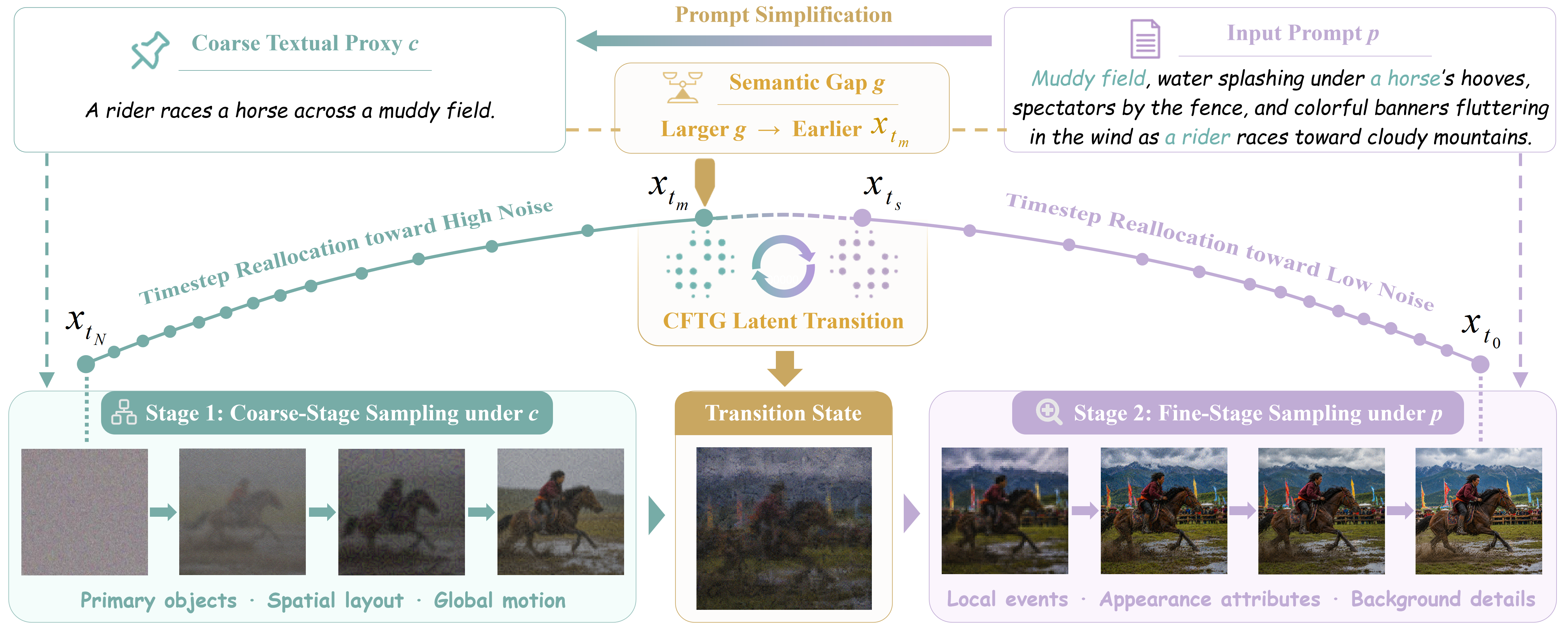
The framework organizes a single denoising trajectory into two complementary semantic stages. A coarse textual proxy derived from the input prompt retains primary objects, spatial layout, global motion, and other coarse-grained semantics, while the original prompt remains the final semantic target. Semantic-Gap-Adaptive Prompt Scheduling determines when generation should move from coarse semantic establishment to fine-grained realization according to how much additional semantic content is present in the original prompt. The first stage uses denser high-noise updates to establish the main scene configuration. At the stage boundary, Coarse-to-Fine Transition Guidance uses the prediction difference between the two text conditions to guide the intermediate latent toward a higher-noise state that can accommodate the additional semantics without discarding the coarse configuration already formed. The second stage then uses denser low-noise updates under the original prompt to realize local events, appearance attributes, background details, and other fine-grained constraints.
ⅠAdaptive Two-Stage Inference Framework
input prompt p
→
coarse textual proxy c
From the original input prompt p, a language model derives a coarse textual proxy c that retains primary objects, spatial layout, global motion, and other coarse-grained semantics while omitting local events, appearance attributes, background details, and overly specific modifiers. The first stage pairs c with denser high-noise sampling, where the latent remains highly flexible for establishing the main scene configuration. The second stage pairs p with denser low-noise sampling, where updates act more directly on local interactions, appearance, and background details. In this way, the semantic responsibility of each stage is matched to the region of the denoising trajectory that provides the most suitable sampling support.
ⅡSemantic-Gap-Adaptive Prompt Scheduling
g = 1 − cos(E(c), E(p))
This module determines the switching point from the coarse textual proxy c to the original input prompt p for each input. Here, E(·) denotes the text embedding model, and E(c) and E(p) are the sentence-level embeddings of c and p, respectively. Their cosine similarity cos(E(c), E(p)) measures how closely the two text conditions are aligned, and the semantic gap g = 1 − cos(E(c), E(p)) is used as a relative proxy for the semantic increment from c to p. A larger g indicates a greater semantic increment and therefore moves the switch earlier, leaving more of the remaining denoising trajectory for the additional constraints in p; a smaller g keeps the coarse stage active for longer. We clip g to a predefined effective range and bound the mapped coarse-stage ratio to prevent extreme similarity estimates from producing an excessively early or late transition, which could make either denoising stage impractically short.
ⅢCoarse-to-Fine Transition Guidance
vguided = vc + λ(vp − vc)
At the switching boundary, the current latent has already followed a denoising trajectory shaped by the coarse textual proxy c, so directly replacing c with the original input prompt p can make the new conditional updates incompatible with the current state. Let v denote the model prediction that determines the text-conditioned latent update at a given latent state and noise level. Evaluating the same state under c and p gives v_c and v_p, respectively, and their difference v_p − v_c captures the change in the denoising update induced by the additional semantics in p. The guidance scale λ controls the strength of this conditional increment. Coarse-to-Fine Transition Guidance uses the resulting guided update to steer a controlled transition toward higher noise, where the latent regains flexibility for fine-grained realization.
ⅣSampling-Budget Reallocation for Two-Stage Inference
Stage 1 · denser high-noise updates
→
Stage 2 · denser low-noise updates
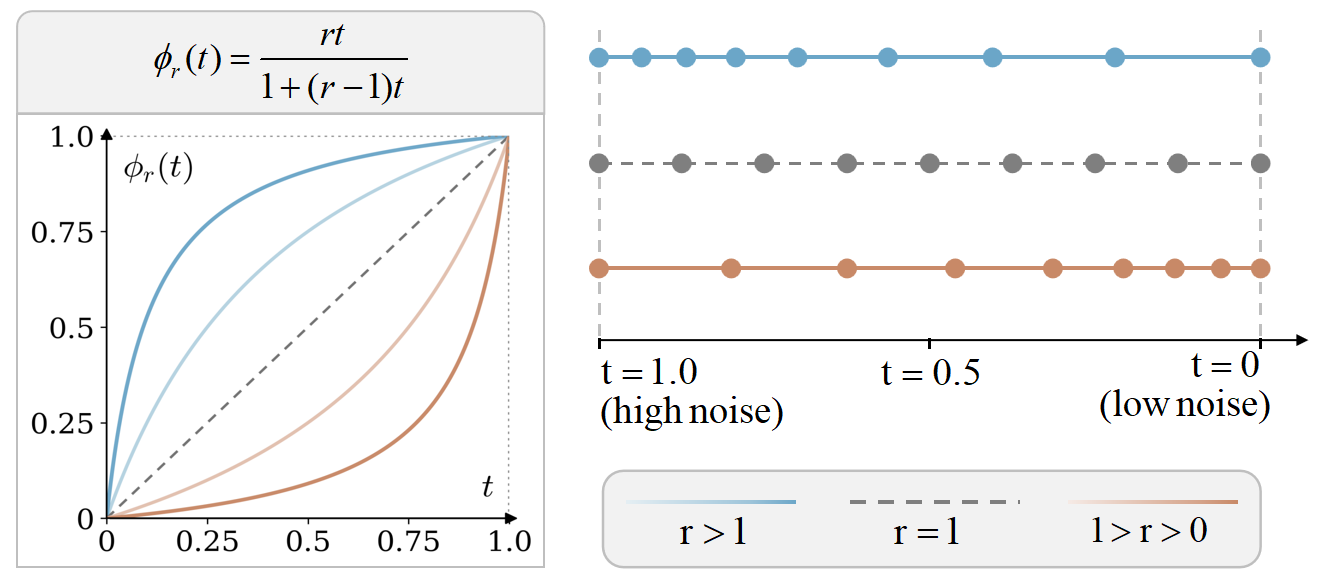
This module redistributes a fixed set of sampling timesteps so that each semantic stage receives denser updates in the noise region most relevant to its role. In the first stage, more sampling points are placed toward high noise, where the latent remains highly malleable and denoising under the coarse textual proxy can establish primary objects, spatial layout, and global motion. In the second stage, more sampling points are placed toward low noise, where denoising under the original prompt acts more directly on local events, appearance attributes, background details, and other fine-grained content. The reallocation preserves the number and order of timesteps, redistributing the same inference budget rather than increasing the number of model evaluations.
Place sampling reallocation figure here assets/images/Sample_Reallocation.png
Baseline vs. Ours
Within each backbone, single-stage input-prompt inference and adaptive two-stage inference are compared under the same prompt across six semantic criteria.
Wan2.2-5B
01
Primary objects
Evaluates whether the prompt-specified primary entities are correctly realized.
Prompt: A green sea turtle swims over coral in a tropical reef, where branching coral rises below its shell, striped reef fish pass beside it, and sun rays filter through clear blue water.
BaselineOurs
02
Spatial layout
Evaluates the relative arrangement and scene configuration specified by the prompt.
Prompt:A river floods over its banks beside a rural road, carrying muddy water, branches, and grass clumps past fence posts and a half-submerged mailbox.
BaselineOurs
03
Global motion
Evaluates the principal motion pattern and large-scale temporal evolution.
Prompt: A person in a yellow ski suit skisfrom the top of a slope to the bottom at a large ski resort. There are many other people on the slopes, the weather is sunny, and the sun is shining.
BaselineOurs
04
Local events
Evaluates localized interactions and event-level changes.
Prompt:White milk swirls into black coffee inside a clear cup, forming curved patterns that fade into light brown liquid.
BaselineOurs
05
Appearance attributes
Evaluates prompt-specified visual properties such as color, material, shape, and texture.
Prompt: A lighthouse stands on the ocean shore, with a tall white tower, rocky coast, waves breaking below, and open sea stretching behind it.
BaselineOurs
06
Background details
Evaluates whether prompt-specified background elements and environmental details surrounding the primary content are correctly realized.
Prompt: A black dog runs happily across a yellow grassy field, with a clear blue sky and some trees in the background.
BaselineOurs
CogVideoX-5B
01
Primary objects
Evaluates whether the prompt-specified primary entities are correctly realized.
Prompt:A house on the seashore stands near waves, with weathered walls, a sandy path, sea foam at the edge, and salt-stained surfaces facing the water.
BaselineOurs
02
Spatial layout
Evaluates the relative arrangement and scene configuration specified by the prompt.
Prompt: An aerial view of a luxurious house with a pool shows blue water, a wide terrace, garden paths, parked cars, and trimmed lawns around the home.
BaselineOurs
03
Global motion
Evaluates the principal motion pattern and large-scale temporal evolution.
Prompt: A chef cuts sushi rolls on a board, pressing a knife through seaweed and rice while neatly sliced pieces line up beside the blade.
BaselineOurs
04
Local events
Evaluates localized interactions and event-level changes.
Prompt: Firewood burns in a dark room, with orange flames, glowing embers, smoke, and flickering light on nearby brick.
BaselineOurs
05
Appearance attributes
Evaluates prompt-specified visual properties such as color, material, shape, and texture.
Prompt: A frozen river stretches across the frame, with pale ice, dark cracks, snow along the banks, and bare trees beside it.
BaselineOurs
06
Background details
Evaluates whether prompt-specified background elements and environmental details surrounding the primary content are correctly realized.
Prompt: A lemur eats grass leaves near low branches, holding the leaves with small hands while its striped tail curls behind it and sunlight falls through the foliage.
BaselineOurs
More Qualitative Results
Additional within-backbone comparisons across diverse content categories, contrasting single-stage input-prompt inference with adaptive two-stage inference under the same prompt.
Wan2.2-5B · Additional Comparisons
Prompt: A red fox leaps over a stream in an autumn birch grove, where fallen orange leaves fly from the bank, wet stones border the water, and thin white trunks stand behind the fox.
BaselineOurs
Prompt: A clown fish swims among sea anemone tentacles, with orange stripes, small fins, waving anemone arms, and coral textures around it.
BaselineOurs
Prompt: A tall sunflower with a heavy yellow head slowly turns in an open farm field, with green leaves twisting along the stem and rows of other sunflowers behind it.
BaselineOurs
Prompt: Orange juice splashes into a tall glass, forming bubbles at the top and droplets on the clear rim.
BaselineOurs
Prompt: A yellow butterfly flies between flowers in an alpine meadow, where purple lupines sway below it, patches of white snow remain on distant slopes, and grass stems bend in the wind.
BaselineOurs
Prompt: A red squirrel runs along a log in a temperate forest floor, where moss covers the fallen trunk, acorns scatter near its paws, and ferns grow around the shaded clearing.
BaselineOurs
Prompt: A baker in a white apron kneads a round dough ball on a floured wooden table, with copper bowls and stacked proofing baskets behind the counter.
BaselineOurs
Prompt: A scuba diver enters a coral reef, releasing bubbles while yellow reef fish pass between branching coral and a blue coral wall rises nearby.
BaselineOurs
CogVideoX-5B · Additional Comparisons
Prompt: A seagull walks along the shore, stepping over wet sand while small waves roll behind it and shell fragments dot the beach.
BaselineOurs
Prompt: A colorful butterfly perches on a flower bud, with patterned wings folded above the petals, green stems around it, and other buds blurred behind.
BaselineOurs
Prompt: People applaud a kids' performance, clapping in rows of seats while children stand on a small stage under bright lights.
BaselineOurs
Prompt: White flowers bloom on a tree in close up, with small petals, yellow centers, thin branches, and green leaves behind them.
BaselineOurs
Prompt: Tree leaves change color during autumn, with green, yellow, and orange leaves mixed across branches and fallen leaves covering the ground.
BaselineOurs
Prompt: A curious cat sits indoors and looks around, with bright eyes, upright ears, a chair behind it, and light from a window crossing the floor.
BaselineOurs
Prompt: A shark swims through open sea, with a gray body, pointed snout, dorsal fin cutting through blue water, and small fish in the distance.
BaselineOurs
Prompt: A cherry tree blooms with pale flowers, with clusters of blossoms along dark branches and petals scattered on the ground.
BaselineOurs
Ablation and Parameter Sensitivity Analysis
Full framework
Adaptive Two-Stage Inference
Prompt: A clown fish swims among sea anemone tentacles, with orange stripes, small fins, waving anemone arms, and coral textures around it.
Component removal
w/o Sampling-Budget Reallocation
Component removal
w/o Coarse-to-Fine Transition Guidance
Schedule sensitivity
Sampling steps overly concentrated in the high-noise region
Schedule sensitivity
Sampling steps overly concentrated in the low-noise region
Transition sensitivity
Switch from coarse textual proxy to input prompt too early
Transition sensitivity
Switch from coarse textual proxy to input prompt too late
Resources
Code and supplementary visual results for the proposed staged inference framework.